Hon. Minister of Finance's Keynote Speech at IADI-ARC Workshop 2026
On behalf of the Federal Government of Nigeria, I thank the Nigeria Deposit Insurance Corporation and the International Association of Deposit Insurers for convening this important gathering at a time when financial systems across the world face both unprecedented opportunities and emerging risks.
Opening
It is my distinct pleasure to welcome you all to Abuja for the 2026 IADI Africa Regional Committee Annual Meeting and Workshop. On behalf of the Federal Government of Nigeria, I thank the Nigeria Deposit Insurance Corporation and the International Association of Deposit Insurers for convening this important gathering at a time when financial systems across the world face both unprecedented opportunities and emerging risks.
The theme of this workshop – Safeguarding Stability: Public Awareness and Crisis Readiness for a Stronger Future – is strategic. It rests on one fundamental truth: there can be no economic growth without financial system stability, and there can be no financial stability without public trust.
Stability as the Foundation for Growth
Financial stability is often discussed in technical terms, yet its impact is felt in the everyday lives of citizens. It affects the ability of businesses to access credit, households to save securely, investors to commit capital, and governments to deliver development programmes. When the public has confidence in financial institutions, savings increase, investment expands, and economic opportunities multiply.
Monetary and fiscal policy alone cannot drive prosperity if the financial sector is vulnerable to panic, capital flight, or systemic distress. The banking system is the nervous system of the macroeconomy. When depositors trust that their money is safe, capital flows productively, credit expands, and businesses grow.
Deposit Insurance as Financial Infrastructure
Historically, deposit insurance was seen as a technical, back-office mechanism for handling bank liquidations after failure. Guided by the revised IADI Core Principles, specifically Core Principle 10 on Public Awareness and Core Principle 11 on Crisis Preparedness we now recognise deposit insurance for what it truly is: a proactive, strategic engine for public trust and economic stability.
Public trust is fragile. In the digital age, rumours and misinformation can spread across social platforms in seconds, creating liquidity shocks even for solvent institutions. If a depositor does not know their funds are protected, they will act on fear. Building public awareness in normal times is not a public-relations exercise; it is a core risk-mitigation strategy, and our messaging must reach every segment of society, from retail depositors and MSMEs to underserved communities in rural areas.
Crisis preparedness follows the same logic. It is not about predicting every shock, but about building systems resilient enough to absorb them. Frameworks, communication channels, and roles must already exist before uncertainty arrives; simulation exercises and coordination mechanisms must already be functioning. Preparedness is therefore not an event, it is a culture.
The most successful crisis response is often the one that never becomes visible, because effective preparation prevented panic from occurring in the first place. That requires seamless, one-voice coordination among the Ministry of Finance, the Central Bank, the Deposit Insurance Corporation, and oversight bodies, so that when a crisis hits, depositors retain swift, certain access to their funds.
Nigeria’s Reform Journey
Nigeria’s reform record speaks directly to the principles this workshop advances. Under the economic reform agenda of President Bola Ahmed Tinubu’s administration, we have pursued a comprehensive programme of fiscal and financial transformation: unifying the foreign exchange market, removing a distortionary fuel subsidy, and ending the Central Bank’s unsustainable Ways and Means financing of government deficits – restoring a critical boundary between fiscal and monetary policy.
Additionally, two important developments bear directly on this audience’s mandate.
First, in March 2026, the Central Bank concluded its two-year banking sector recapitalisation exercise. Thirty-three of Nigeria’s thirty-seven banks met the revised minimum capital requirements ranging from ₦500 billion for internationally authorised banks to ₦50 billion for regional banks raising a combined ₦4.65 trillion (over USD3.5 Billion) in fresh capital, over 70 per cent of it from domestic investors.
Capital adequacy ratios across the sector now exceed Basel benchmarks, and all banks continued to operate normally throughout, with no disruption to customer access. A better-capitalised banking system is a more resilient one, better able to absorb shocks and sustain lending without recourse to the deposit insurance fund. For deposit insurance, the significance is direct: stronger bank balance sheets mean a stronger financial safety net.
Second, in October 2025, Nigeria was officially removed from the Financial Action Task Force grey list, a designation that had constrained our financial system since February 2023. This was the product of two years of sustained, coordinated reform across our Financial Intelligence Unit, the Central Bank, the EFCC, and the Ministry of Justice – strengthening our anti-money laundering framework, operationalising a national beneficial ownership register, and improving inter-agency coordination. A financial system credible in the eyes of the world is one in which depositors are more likely to place, and keep, their confidence.
Deposit Insurance and Inclusive Growth
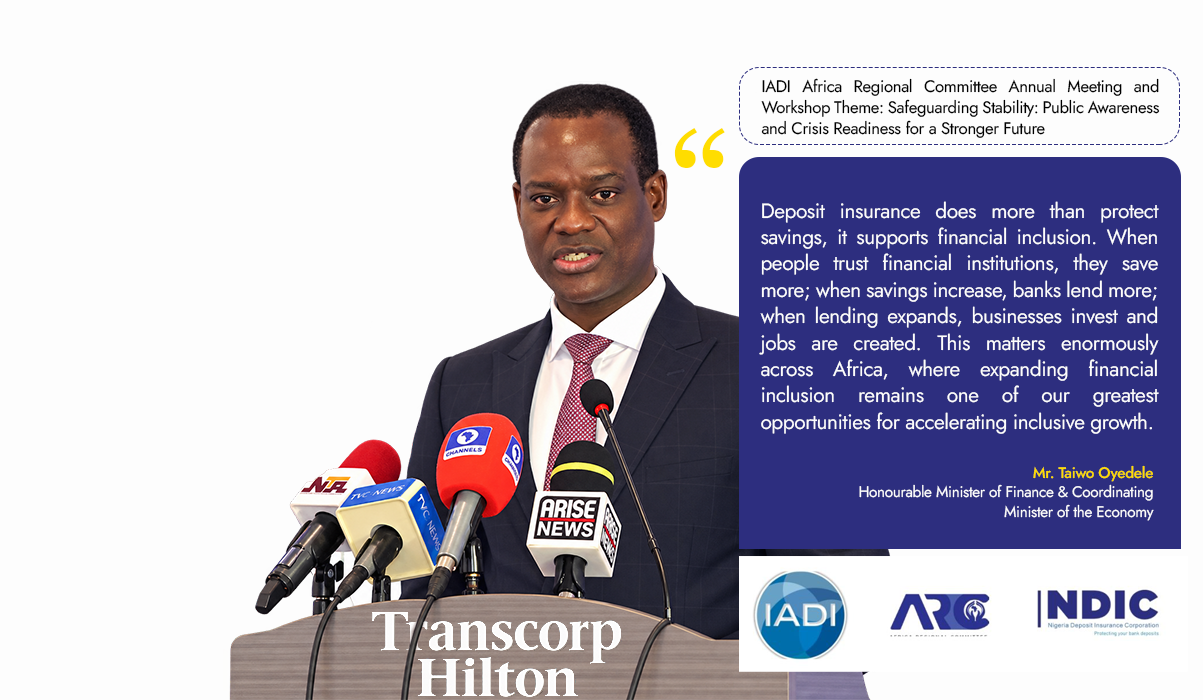
Deposit insurance does more than protect savings, it supports financial inclusion. When people trust financial institutions, they save more; when savings increase, banks lend more; when lending expands, businesses invest and jobs are created. This matters enormously across Africa, where expanding financial inclusion remains one of our greatest opportunities for accelerating inclusive growth.
A Continental Imperative
Africa’s financial landscape is evolving rapidly. Cross-border banking, fintech innovation, and digital payment rails mean instability no longer respects geographical borders, even as the African Continental Free Trade Area opens enormous opportunities for trade and investment. Realising them requires financial systems resilient enough to manage emerging risks together.
This is why platforms like the IADI Africa Regional Committee matter: they align our frameworks with international best practice while adapting them to African realities. And Africa should not merely adopt global standards, we should help shape them. Our populations are younger, our mobile money penetration is among the highest in the world, and our experience navigating financial inclusion at scale offers lessons for the global community. No single institution preserves financial stability alone – central banks, deposit insurers, supervisors, finance ministries, resolution authorities, and the media each have a role to play, and our coordination must be as seamless as the crises we prepare for.
Conclusion
Let me close with one simple thought: confidence cannot be legislated, purchased, or imposed. It must be earned – through strong institutions, transparency, effective communication, preparedness, and consistent action. The stronger our institutions, the greater the confidence they inspire; the greater the confidence, the more resilient our financial systems become; and the more resilient our financial systems, the stronger our economies and the greater the prosperity we can create for our people.
I commend the International Association of Deposit Insurers, the Africa Regional Committee, and the Nigeria Deposit Insurance Corporation for convening this important dialogue.
Over the next few days, as you deliberate on how to operationalise IADI Core Principles 10 and 11, I urge you to keep the ultimate beneficiary in mind: the ordinary African citizen.
Every framework you refine, every simulation you run, and every communication strategy you design protects the savings of a small business owner, the salary of a worker, and the financial integrity of our nations.
I wish you fruitful, insightful, and impact-driven deliberations.
On this note, it is my honour to declare the 2026 IADI Africa Regional Committee Workshop officially open.
God bless the Federal Republic of Nigeria,
God bless your respective nations; and God bless Africa.
Thank you.